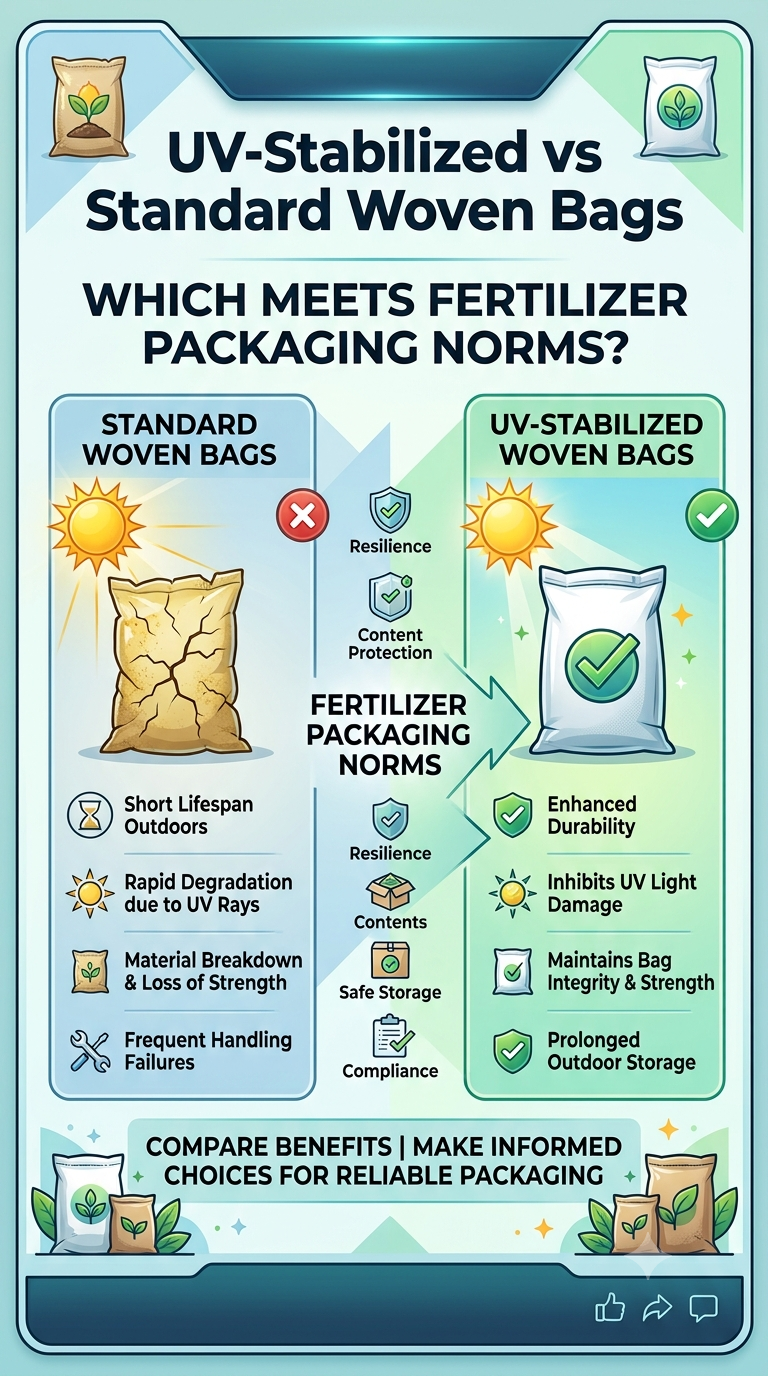
Fertilizer packaging in India isn’t just about holding product — it’s about surviving months of outdoor storage, meeting Fertiliser Control Order (FCO) specifications, and protecting nutrient quality until the bag reaches a farmer’s field. One of the most overlooked decisions in this chain is a simple one: should you use UV-stabilized woven bags or standard PP woven bags?
For fertilizer manufacturers, cooperatives, and distributors sourcing packaging at scale, this choice affects compliance, shelf life, and cost. Here’s a breakdown to help you decide.
Why UV Stabilization Matters for Fertilizer Bags
Fertilizer bags rarely move straight from factory to field. They sit in open yards, warehouses with tin roofs, and transit trucks — often for weeks under direct sunlight. Polypropylene, the base material in PP woven bags, is naturally vulnerable to UV degradation. Without protection, prolonged sun exposure breaks down the polymer chains, causing:
- Reduced tensile strength and seam integrity
- Bag brittleness and tearing during handling or stacking
- Faster degradation of print quality on branded bags
- Potential product leakage or contamination
UV-stabilized woven bags are manufactured by adding UV stabilizer additives during the extrusion process, which slows this breakdown significantly — typically extending outdoor-storage life from a few weeks to 6–12 months or more, depending on additive dosage and bag thickness.
Standard Woven Bags: Where They Still Work
Standard (non-UV) woven bags aren’t obsolete — they’re simply suited to different conditions. If your fertilizer moves quickly through the supply chain with minimal outdoor dwell time, or is stored indoors in covered warehouses, standard HDPE/PP woven sacks can be a cost-effective choice. They cost less to produce since they skip the UV additive, which matters for high-volume, price-sensitive buyers.
The risk: if storage or transit conditions change — a delayed shipment, an unexpected yard stopover, a monsoon-season delay — standard bags degrade faster and may not hold up to the tensile and seam-strength testing required under quality protocols.
What Fertilizer Packaging Norms Actually Require
Under the Fertiliser Control Order (1985) and subsequent packaging notifications, fertilizer bags must meet defined standards for weight accuracy, printing (including the mandatory “Bharat” branding under the One Nation One Fertilizer scheme), and physical durability. While the FCO doesn’t universally mandate UV stabilization for every fertilizer grade, most large manufacturers and cooperatives — including IFFCO, cement-linked fertilizer units, and state marketing federations — specify UV-stabilized bags as a de facto requirement in their procurement standards, precisely because:
- Bags are frequently stored outdoors at godowns and dealer points for extended periods.
- Torn or degraded bags create weight-shortage disputes and compliance issues at the point of sale.
- Faded printing on non-UV bags can obscure mandatory subsidy and brand markings, which is a direct compliance risk under the branding norms.
In practice, UV-stabilized woven bags are the safer choice for meeting both the letter and the intent of fertilizer packaging norms — especially for NPK, DAP, and MOP bags that pass through multi-stage distribution networks before reaching farmers.
Quick Comparison
Factor | UV-Stabilized Woven Bags | Standard Woven Bags |
Outdoor storage life | 6–12+ months | Weeks to a few months |
Tensile strength retention | High, even after sun exposure | Degrades faster under UV |
Print/branding durability | Maintains compliance markings longer | Fading risk affects mandatory branding |
Cost | Slightly higher (additive cost) | Lower upfront cost |
Best suited for | Long storage, multi-tier distribution, seasonal stockpiling | Fast-moving stock, indoor/covered storage |
Choosing the Right Bag Specification
When specifying woven sacks for fertilizer packaging, consider:
- Expected storage duration at godowns and dealer points before dispatch to farmers
- Denier and GSM of the fabric, alongside UV additive dosage — a higher GSM without UV protection still won’t survive extended sun exposure
- Regional climate — bags stored in high-UV, high-heat regions need stronger stabilization than those in temperate zones
- Compliance requirements tied to weight accuracy, seam strength, and mandatory branding under current fertilizer packaging norms
The Bottom Line
If your fertilizer packaging spends any meaningful time outdoors — which is true for most distribution models in India — UV-stabilized PP woven bags are the more reliable choice for meeting fertilizer packaging norms without risking torn bags, faded compliance markings, or product loss. Standard woven bags remain viable only for tightly controlled, fast-turnaround, indoor-storage scenarios.
At Aura Plastics, we manufacture both UV-stabilized and standard PP/HDPE woven bags, engineered to meet tensile strength, seam integrity, and print-quality benchmarks required across agriculture, cement, and chemical packaging. Our in-house testing lab verifies every batch against these standards before dispatch.
Looking for fertilizer-grade woven bags that meet compliance and durability requirements? Get in touch with our packaging experts for a specification recommendation suited to your storage and distribution needs.