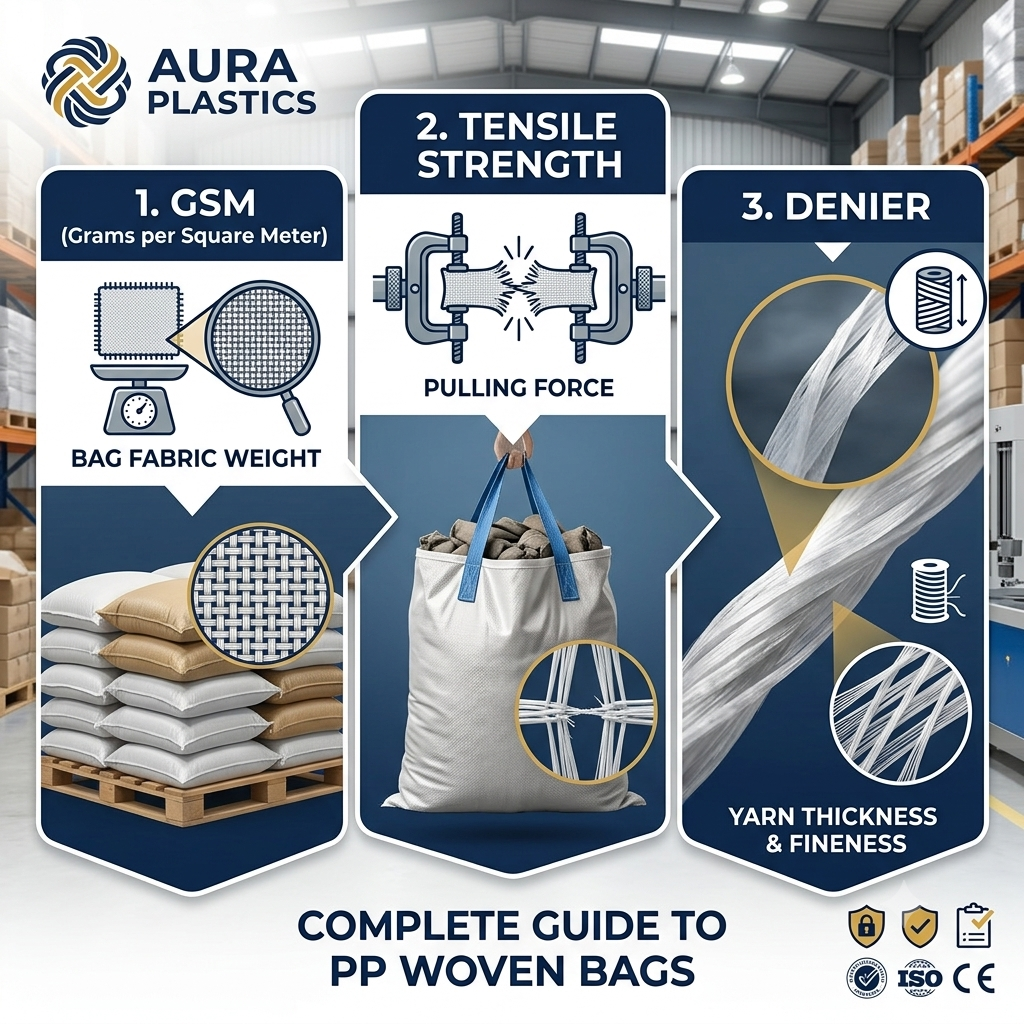
Selecting the right PP woven bags is not just about cost—it’s about performance, safety, and reliability. Whether you are in agriculture, cement, chemicals, or food grains, understanding key technical parameters like GSM, tensile strength, and denier can significantly impact your packaging efficiency.
This guide breaks down these essential concepts in a simple, practical way to help you make better decisions.
What is GSM in PP Woven Bags?
GSM (Grams per Square Meter) refers to the weight of the fabric per unit area. It is one of the most basic indicators of bag strength and durability.
Why GSM Matters:
- Higher GSM = Thicker & stronger fabric
- Lower GSM = Lightweight & cost-effective
- Directly impacts load-bearing capacity
Practical Insight:
- 50–70 GSM → Light-duty applications (fertilizers, grains)
- 70–100 GSM → Medium-duty (food products, animal feed)
- 100+ GSM → Heavy-duty (cement, chemicals, minerals)
👉 Choosing the wrong GSM can either lead to bag failure or unnecessary cost increase.
What is Tensile Strength?
Tensile strength measures how much force a PP woven bag can withstand before breaking. It is tested in both:
- Warp direction (lengthwise)
- Weft direction (crosswise)
Why It’s Critical:
It determines resistance to tearing and breakage, it is essential for stacking, lifting, and transportation, and impacts safety during handling
High tensile strength ensures your bags don’t fail under pressure—especially in bulk handling and export shipments.
What is Denier in PP Woven Fabric?
Denier refers to the thickness of individual polypropylene tapes (filaments) used in weaving the fabric.
Simple Definition:
Denier = Weight (in grams) of 9,000 meters of yarn
Why Denier Matters:
- Higher denier = Thicker tapes, stronger fabric
- Lower denier = Finer tapes, smoother finish
- Influences fabric strength, flexibility, and appearance
- Denier directly impacts both strength and aesthetics, especially in BOPP laminated bags.
How GSM, Tensile Strength & Denier Work Together
| Parameter | Impacts |
Key Benefit |
|---|---|---|
| GSM | Fabric weight | Load capacity |
| Tensile Strength | Resistance to breakage | Safety & durability |
| Denier | Tape thickness | Strength + finish quality |
Real-World Example:
A cement manufacturer requires:
- High GSM (for load-bearing)
- High tensile strength (for stacking)
- High denier (for durability)
Whereas a rice exporter may prefer:
- Moderate GSM
- Balanced tensile strength
- Lower denier for better print finish
Common Mistakes Buyers Make
- Choosing low GSM to reduce cost, leading to bag failures
- Ignoring tensile strength specifications
- Not aligning denier with application needs
- Over-specifying material and increasing unnecessary costs
👉 The key is application-based customization, not one-size-fits-all.
How to Choose the Right PP Woven Bag
When selecting your packaging, always consider:
- Type of product (powder, granules, bulk)
- Weight per bag
- Handling conditions (manual vs automated)
- Storage & transportation requirements
- Environmental factors (moisture, UV exposure)
Why Technical Understanding Matters More Than Ever
With increasing demand for export-quality packaging, compliance standards, and cost optimization, businesses can no longer rely on generic specifications.
Understanding GSM, tensile strength, and denier helps you:
- Reduce product loss and damage
- Improve supply chain efficiency
- Ensure customer satisfaction
- Optimize packaging costs
At Aura Plastics, we specialize in high-performance PP woven sacks and fabrics tailored to your exact requirements.
✔ Advanced manufacturing across multiple facilities
✔ Strict quality control on GSM, denier & tensile strength
✔ Custom solutions for agriculture, cement, chemicals & food industries
✔ Trusted by leading brands like Godrej Agrovet, Olam, ITC, LT Foods, and LDC