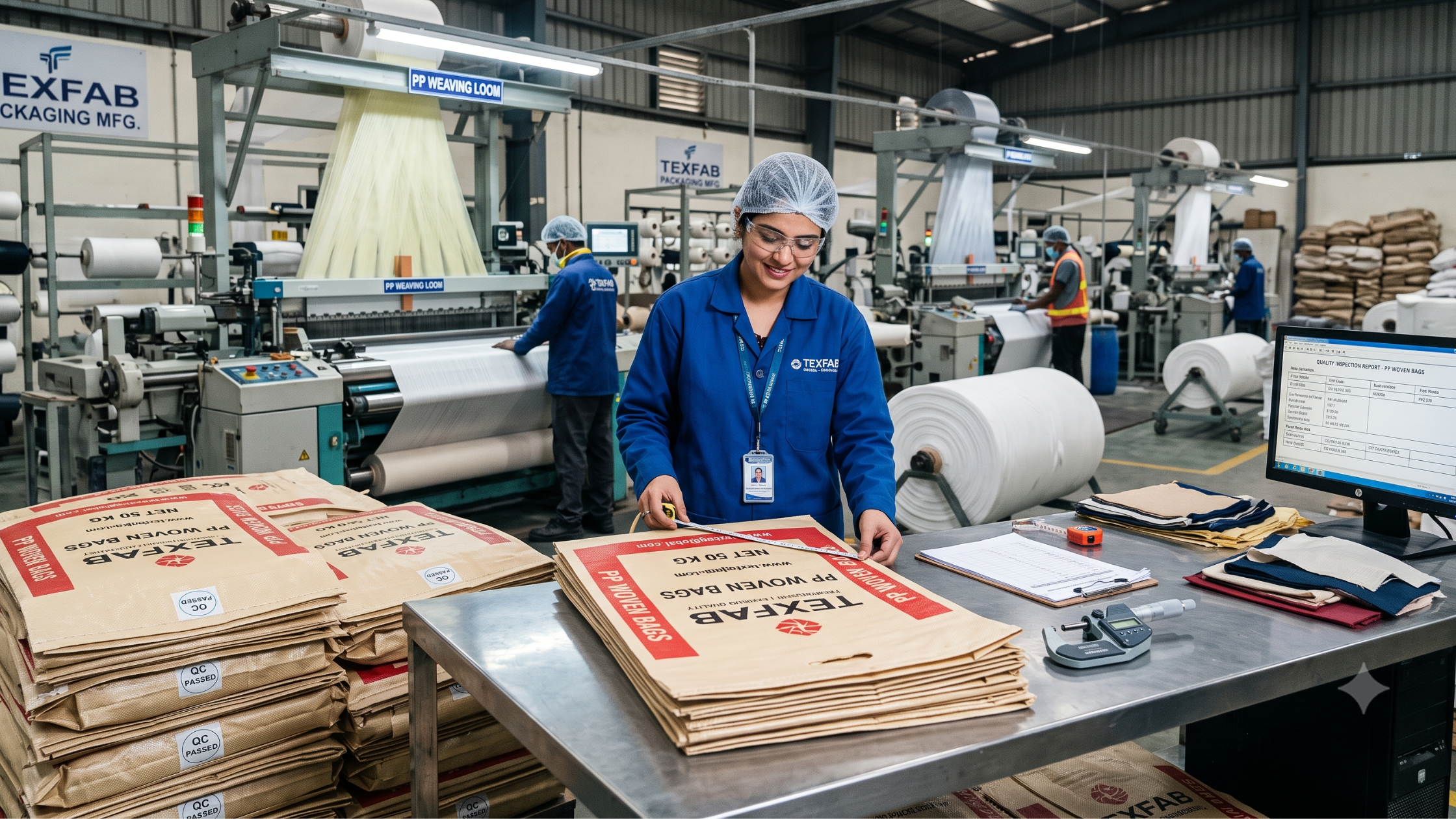
A torn cement bag on a construction site. A grain sack that bursts mid-stack in a warehouse. A woven fabric roll that delaminates the first time it’s exposed to sun and rain. In the world of PP (polypropylene) woven bags and fabric, quality failures aren’t abstract — they show up as spilled products, damaged reputations, and costly claims from customers who trusted the packaging to hold up.
At Aura Plastics, quality control for PP woven bags and fabric isn’t a single inspection step — it’s a set of checks built into every stage of production, from raw resin to the finished, stitched bag. Here’s how that process works.
It Starts With the Resin
PP woven bags are only as strong as the polypropylene granules they’re extruded from. Before any resin is approved for production,we check it for:
- Melt flow index (MFI) — to ensure the resin extrudes consistently into uniform tape
- Purity and contamination levels — since even small impurities can create weak points in the yarn
- UV stabilizer content — critical for bags and fabric that will be stored or used outdoors, where unprotected PP degrades quickly under sunlight
Resin batches that don’t meet spec are rejected before they ever reach the extrusion line. This matters because problems introduced at the resin stage don’t stay contained — they carry through tape, fabric, and finished bag, showing up as failures long after the product has left the factory.
Tape Extrusion: Where Strength Is Built or Lost
The PP tape (the flat yarn woven into fabric) is where much of a bag’s strength originates. We monitor several variables closely during extrusion:
- Tape width and thickness (denier) — checked at regular intervals to catch drift before it affects fabric weight or strength
- Tensile strength and elongation — tested on sample tape to confirm it meets the load-bearing requirements for the intended application, whether that’s a lightweight shopping bag or a heavy-duty bulk bag
- Stretch ratio and drawing temperature — controlled precisely, since inconsistent drawing produces tape that’s either brittle or under-oriented, both of which weaken the final fabric
Sample tape from each production run is pulled and tested on tensile testing equipment, comparing actual breaking strength against the specification for that product line.
Weaving: Consistency Is the Whole Game
Once tape becomes fabric, consistency is what separates a reliable bag from one that fails under load. On the circular and flat weaving looms, Aura Plastics tracks:
- Picks per inch (PPI) — the density of the weave, which directly affects burst strength and how well the fabric resists fraying or unraveling
- Fabric GSM (grams per square meter) — checked against target specs, since even small deviations affect both strength and cost consistency
- Weave uniformity — visual and automated inspection for missing tapes, uneven tension, or loose weaving that could create weak spots
- Width tolerance — fabric rolls are measured to ensure they meet the width required for downstream cutting and stitching, minimizing waste and rework
Loom operators are trained to recognize early signs of tension imbalance or tape breakage, since catching these issues mid-run prevents an entire roll of fabric from being downgraded.
Lamination and Printing: Function Meets Presentation
Many PP woven bags require lamination — a thin layer of BOPP or PP film bonded to the woven fabric — to improve moisture resistance, printability, or barrier properties. We check laminated fabric for:
- Bond strength, to make sure the laminate film doesn’t peel or bubble during handling or printing
- Moisture barrier performance, especially important for bags holding products like fertilizer, animal feed, or food-grade goods
- Print registration and color consistency, so that branded bags come out sharp and uniform across large production runs — a detail that matters as much to a customer’s shelf presence as the bag’s strength does
Bag Conversion: Cutting, Stitching, and Final Assembly
The final stage — cutting, stitching, and finishing bags — is where a lot of hidden defects can surface if they haven’t been caught earlier. We run quality checks at this stage covering:
- Stitch type and stitch density, since under-stitched seams are one of the most common causes of bag failure at the point of filling
- Bottom and valve sealing, tested for leak resistance on bags designed to hold fine powders like cement or flour
- Bag dimensions, verified against customer specifications to ensure consistent fit with filling machinery
- Drop testing and burst strength testing, simulating real-world handling — filled bags are dropped from standard heights and tested for the load they can bear before failure, matching the actual weight and stacking conditions the bag will face in transit and storage
Traceability From Roll to Bag
Every roll of fabric and every batch of finished bags is tagged and tracked back to its resin lot, extrusion run, and weaving shift. If a quality issue is identified — whether through internal testing or customer feedback —We trace it back to its source quickly, isolate the affected batch, and prevent a narrow issue from becoming a wider recall.
This traceability also feeds continuous improvement: recurring issues linked to a particular loom, tape line, or resin lot get flagged for root-cause investigation rather than treated as isolated incidents.
Why This Matters for Buyers
For businesses sourcing PP woven bags or fabric — whether for agriculture, construction materials, chemicals, or retail packaging — quality control that’s invisible in the sales pitch becomes very visible the moment a shipment fails. A rigorous, multi-stage QC process like this one helps prevent:
- Bags that burst or tear during filling, stacking, or transit
- Inconsistent fabric weight that throws off cost calculations and load ratings
- UV degradation that shortens a bag’s usable life in outdoor storage
- Print and branding inconsistencies across large orders
The strength of a woven bag isn’t really tested until it’s stacked ten high in a warehouse or dragged across a loading dock. Quality control at every stage — resin, tape, weave, lamination, and stitching — is what makes sure it holds up when it counts.